Saint / folklore
fertility offering superstition
Background
A gesture read as a survival of ancient fertility worship.
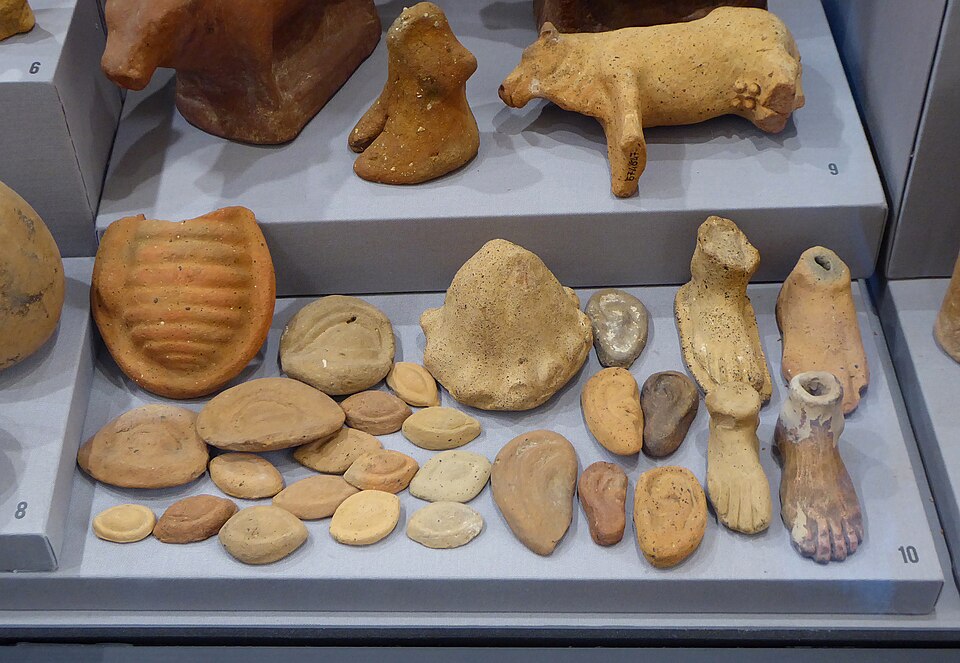
Lewis, like many observers of southern Italy, kept seeing traces of pre-Christian cult under Catholic practice. Campania offers plenty of material for the idea. The Matres Matutae of Capua are hundreds of tufa statues of seated mothers holding swaddled infants, offered to a mother-goddess between the sixth and first centuries BC. Temples across the region yielded thousands of terracotta votive wombs, breasts and genitals. Pompeii is full of phallic amulets against misfortune.
Whether particular modern gestures really descend from such cults is hard to prove. Folklorists now tend to be more cautious than earlier writers about “survivals”, noting that customs are reinvented as often as they are inherited. But the continuity of function is striking: offering a body part to a protector in exchange for health or fertility runs unbroken from the ancient votive deposits to the silver ex-votos still pinned around Neapolitan altars.
In Naples ’44
A woman’s ritual gesture that Lewis takes for an offering to a fertility deity — one of the glimpses of pre-Christian cult he keeps catching in and around Naples.
Appears in 1 diary entry.
-
October 24 1944Lewis is abruptly ordered to a new mission repatriating Russian ex-POWs, sensing this marks the end of his time in Naples.
a woman's ritualized gesture interpreted as an offering to a fertility deity
Use ← → to move between pages