Saint / folklore
evil eye
Background
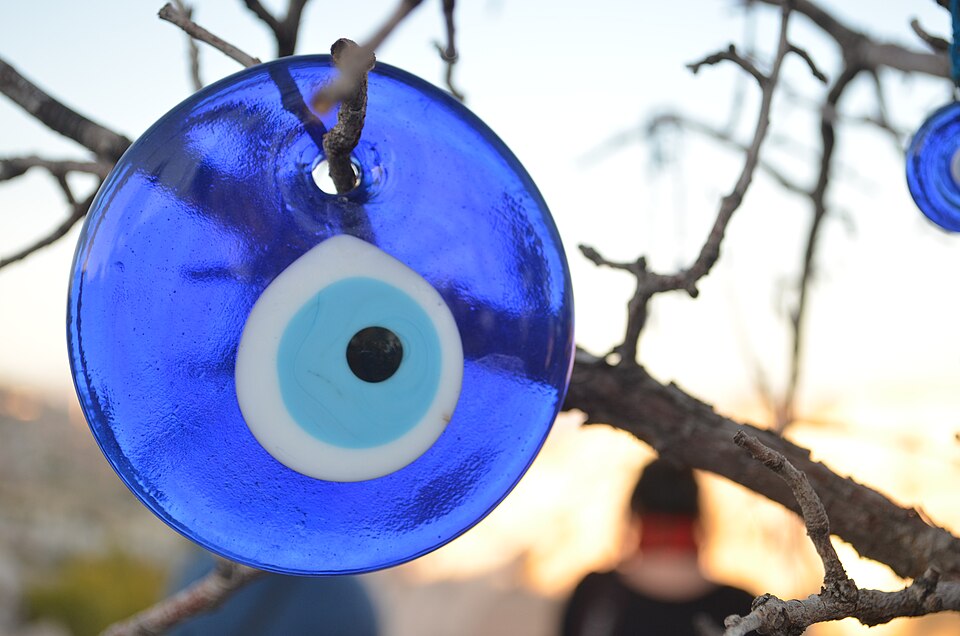
The evil eye is a supernatural belief in a curse brought about by a malevolent glare, usually inspired by envy. Amulets to protect against it have been found dating to around 5,000 years ago. It is found in many cultures in the Mediterranean region, the Balkans, Eastern Europe, West Asia, Central Asia, South Asia, Africa, the Caribbean, and Latin America, with such cultures often believing that receiving the evil eye will cause misfortune or injury, while others believe it to be a kind of supernatural force that casts or reflects a malevolent gaze back upon those who wish harm upon others.
Naples distinguishes two related ideas. The malocchio is the harm anyone can do with an envious look, often without meaning to. Jettatura is a permanent, involuntary power possessed by certain people, the jettatori, whose mere presence brings misfortune. The jettatore was a fixture of eighteenth-century Neapolitan society. The magistrate Nicola Valletta wrote a half-serious treatise on him (1787), and the fear outlived the Enlightenment comfortably.
The defences are many. There is the corno or cornicello, a twisted red horn, ideally of coral, handmade, and received as a gift rather than bought for oneself. There are hand gestures such as the mano cornuta (index and little finger extended). Touching iron helps, as does, for men, a discreet touch of the genitals. Removing a malocchio is a job for a specialist, often an elderly woman. She diagnoses it by dripping oil into a dish of water and reciting a formula passed down, by tradition, only on Christmas Eve.
Evil eye · Malocchio (it) · Nicola Valletta (it) · Cornicello · Corno portafortuna (it) · Sign of the horns
· Wikipedia ↗ · Search Google ↗In Naples ’44
The pervasive Neapolitan dread of the malevolent glance — coral-horn amulets in every jeweller’s window, a Via Carducci block shunned as cursed, a woman blamed for poisoning a village water supply — and, by September 1944, the Benevento notables making protective gestures at Lewis himself, taking him for a jettatore.
Appears in 3 diary entries.
-
October 8 1943Floods of dubious civilian tips overwhelm the section, including a "spy" who turns out to be rumored a witch by superstitious villagers.
local witch belief; villagers convinced a woman could curse the water supply
-
December 9 1943
-
September 23 1944Lewis realizes with unease that locals now regard him as a possible *jettatore* (bearer of the evil eye), noting superstitious gestures made in his presence. He then reflects that a year after liberation, still hungry and diseased amid lawless ruins with only the distant promise of corrupt democracy ahead, Neapolitans may reasonably look back on the Mussolini years as a lost paradise by comparison.
jettatore superstition; protective gestures made against Lewis himself
Use ← → to move between pages